Fix the system, not the human.
The Humanics Method is how I help NDIS providers cut the admin chaos without losing the human side of the work. Practical systems for real humans, built with your team and tested against what your participants actually experience.
Why I built it
You started your NDIS business because you give a damn about participants. Then the admin arrived.
Incident reports. Rosters. Audit evidence. Another spreadsheet. Another "quick fix" that becomes the way things are done. Slowly, quietly, the work drifts away from what you set out to do. I call it values drift, and I've watched it happen in provider after provider.
I've seen it from the inside, as a SIL Service Delivery Manager and a SIL Client Relationships Manager (referrals, intake, onboarding), and for a short time as a Support Coordinator. I know what it's like when the policy on paper says one thing and a Tuesday afternoon in a house says another.
Here's what I also know: it's almost never because your people are lazy, careless or don't care. It's because the system let it happen.
So I stopped asking "who dropped the ball?" and started asking "what let it drop?"
That question is the whole Humanics Method.
What Humanics actually is
The Humanics Method is a way to streamline your NDIS operations while looking after your participants and your team at the same time. Not one or the other.
It's built on Todd Conklin's human performance principles, my own years inside provider operations, and what the research says about keeping good staff. And it rests on one belief: ethical, sustainable business practice is good business sense. It's not a soft add-on.
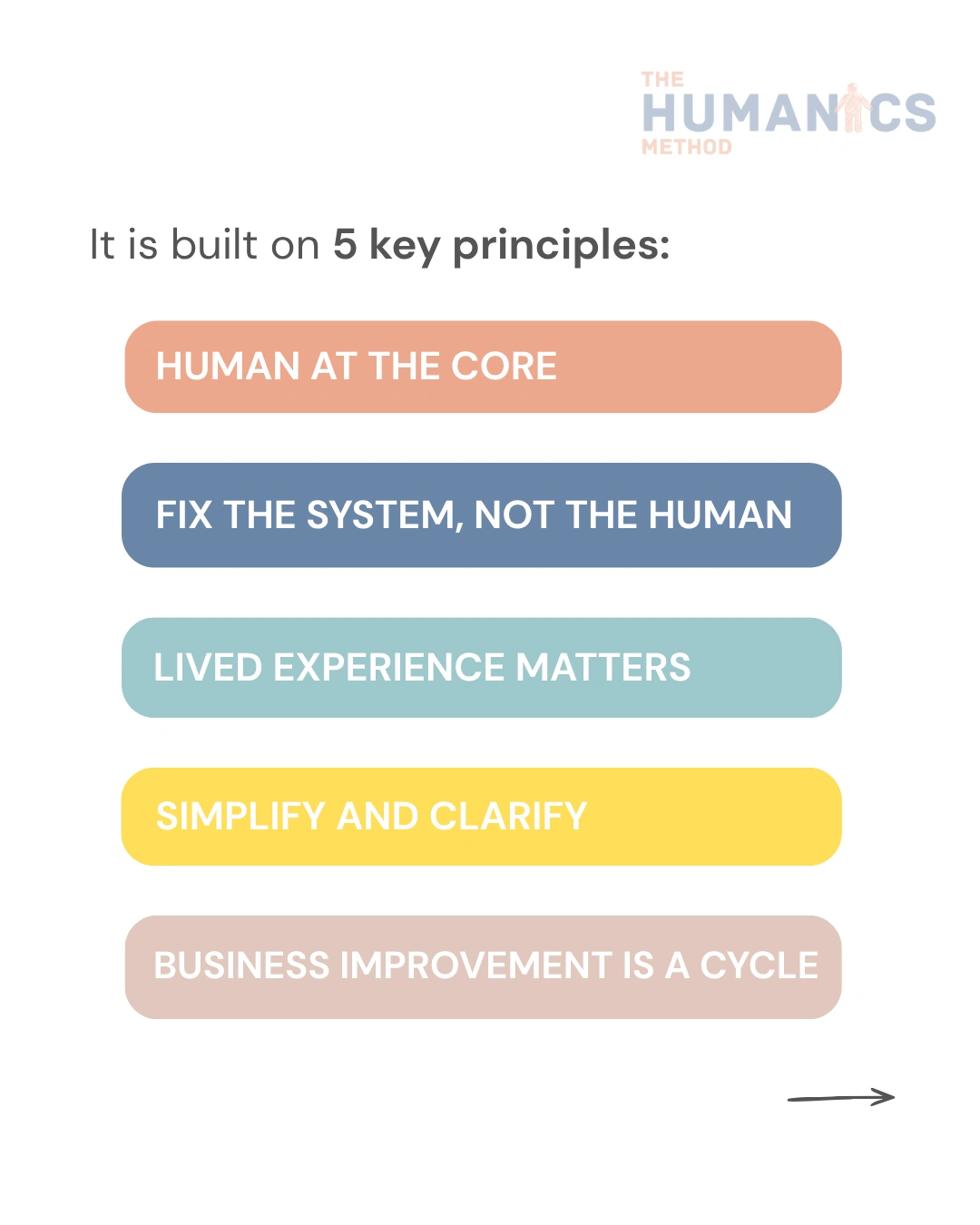
Five principles sit underneath everything I do.
Human at the core. Supporting humans to support humans. Operations designed around the participant experience and the realities of how your team actually works under pressure.
Fix the system, not the human. Before we look at people, we look at systems, training and leadership. Your team should feel safe to say "this could be done better", and your participants should never be made to feel like the problem.
Lived experience matters. If you've lived it, you get it. If you haven't, listen to those who have. Participant, family, team and Support Coordinator feedback all shape the work.
Simplify and clarify. Say what you mean and mean what you say, so you can explain exactly how you meet participant needs, and your participants agree because it's true.
Business improvement is a cycle. Not a box you tick when an audit rolls around. A mindset that lives in your systems, alongside risk management, performance management and support planning.
The six steps
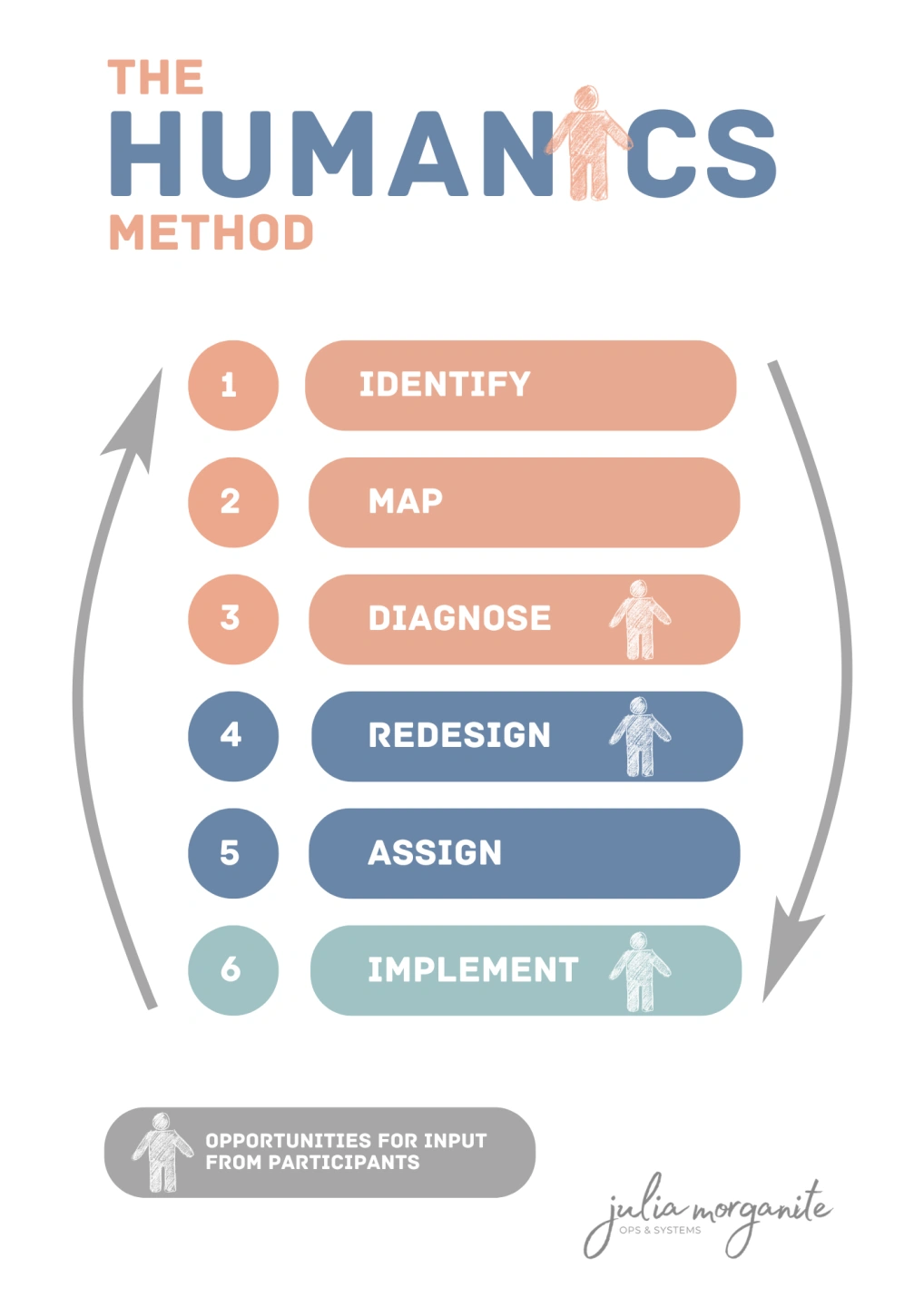
One method, six steps. The first three find out what's really going on. The last three fix it.
Diagnose
Identify your core business functions. We map what your business actually does, not what the org chart says it does.
Map what's really happening. We find out what happens day to day, versus what's written down and what everyone assumes.
Find the gaps, bottlenecks and breakpoints. We pin down exactly what's costing you time, risk and sleep, and rank it by what matters most.
Fix
Redesign the workflows that need fixing. We rebuild the broken process into something your team can actually follow, with the people it affects helping shape it.
Assign ownership, roles and responsibilities. Everyone knows who owns what, so it doesn't quietly fall apart again in six months.
Turn the map into action. We roll it out properly, with your team, until it's running in real life and not filed in a folder.
The depth you need depends on where you're at, which is why you can start small. But it's always the same method, and it always keeps the same question at the centre: is this actually better for the people living it?
I don't hand you a document and disappear. I'm not interested in making your paperwork look good. I'm interested in whether the experience changed.
Who Humanics is for (and who it's not)
Humanics is for the providers who:
care deeply about participants but are drowning in admin
are growing faster than their systems, and can feel it
are sick of patching problems instead of fixing them
dread audit season, and know a policy on paper isn't the same as risk management
want their support workers to feel heard, trained and trusted
are willing to listen to feedback from their team and their participants, even when it's uncomfortable
It's built for SIL providers, services that employ support workers at scale, Support Coordination, and registered providers where the audit and compliance stakes are higher.
Humanics is not for providers who are happy to keep drowning in chaos and ignoring feedback from their teams and their participants. You're not my people. Don't book a call with me.
And it's not for anyone after a superficial attempt to look more person-centred. I'm not a tick-box credential, and I won't be bolted onto your marketing as one.
I mean what I say and I say what I mean. Results also depend on you showing up and doing your part. I'll guide you, but it's your business.
How to start
You don't need to fix everything at once. You need to fix the right thing first.
Start small: Tier 1 Snapshot for $299
A low-risk look at where things are breaking and why. You get a clear, plain-English picture of your biggest problem and what to do about it, so you know where to start before you commit to anything bigger.
Look wider: Tier 2 Systems Triage for $1,900
A diagnosis across three parts of your business that shows how problems that seem separate are actually connected, with evidence your leadership team or board can act on.
Go deeper: Tier 3 Full Humanics Process from $5,000
When you're ready to fix it properly, we work through the whole method together: diagnosis, redesign, ownership and rollout. Pricing starts at $5,000, and I'll confirm your quote after our free 30-min chat, so there are no surprises.